
Understanding the Different Types of Machine Learning in eCommerce
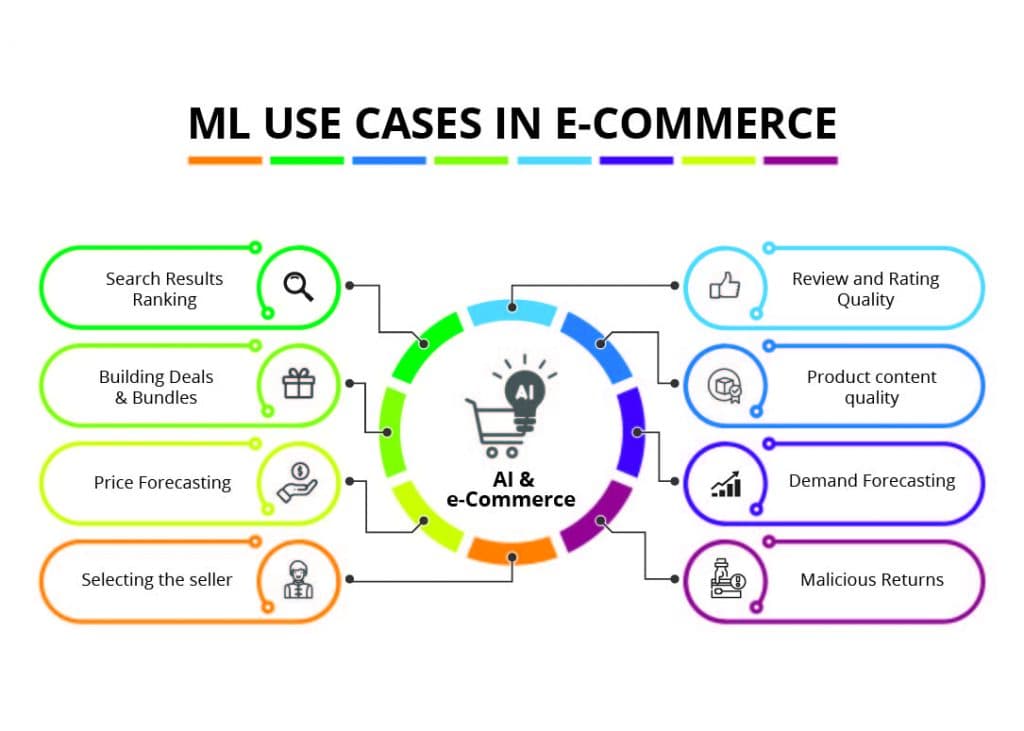
Machine learning (ML) has been transformative for eCommerce, powering everything from personalized recommendations to inventory management. In this blog post, we'll delve into the five main types of machine learning used in eCommerce and other industries. We’ll explore how each type functions, their common algorithms, and their practical applications in the eCommerce landscape.

1. Supervised Learning
Overview
Supervised learning is a type of machine learning where the model is trained on a labeled dataset. This data includes input-output pairs, where the output is known and used to guide the training process.
Common Algorithms
- Linear Regression: Used for predicting a continuous output based on input features. For example, forecasting sales based on historical data.
- Decision Trees: These models make predictions by learning decision rules from the features of the data. They're particularly useful for classification tasks like predicting whether a customer will churn.
- Support Vector Machines (SVM): Effective for both regression and classification, SVM works well with high-dimensional spaces.
Real-World Application
In eCommerce, supervised learning can predict customer churn by analyzing customer purchasing history. Features such as purchase frequency, average cart value, and customer service interactions can be used to train a model. For example, an eCommerce platform might use supervised learning to flag customers who haven't purchased in a while and then target them with personalized discounts to prevent churn.

2. Unsupervised Learning
Overview
Unsupervised learning operates without labeled outputs, letting the algorithm discover patterns and relationships within the data on its own.
Common Algorithms
- K-means Clustering: Groups data points into clusters based on feature similarity.
- Principal Component Analysis (PCA): Reduces the dimensionality of data, making it easier to visualize and analyze.
Real-World Application
In eCommerce, unsupervised learning can segment customers based on their purchasing behavior. This helps in creating targeted marketing strategies. For instance, a retailer could use clustering algorithms to identify customer segments such as bargain hunters, frequent buyers, and high spenders, allowing for more tailored promotional campaigns.

3. Reinforcement Learning
Overview
Reinforcement learning involves training an agent to make decisions by rewarding desired behaviors and punishing undesired ones. The agent interacts with the environment and improves over time.
Common Algorithms
- Q-Learning: A model-free algorithm that seeks to learn the value of actions in states to maximize some notion of cumulative reward.
Real-World Application
In eCommerce, reinforcement learning can optimize inventory management by learning the best stock levels for various products. For example, an online grocery store might use reinforcement learning to identify the optimal restocking policies that minimize spoilage while ensuring product availability.

4. Generative AI
Overview
Generative AI, a subset of unsupervised learning, excels at creating new, synthetic instances of data that resemble the training set.
Common Algorithms
- Generative Adversarial Networks (GANs): Consist of two models (a generator and a discriminator) that learn by competing against each other.
Real-World Application
An eCommerce site could use generative AI to create new product designs or generate realistic images of virtual models showcasing clothing. For example, fashion retailers can use GANs to generate images of clothing items on different body types, helping customers visualize how products might look on them.

5. Deep Learning
Overview
Deep learning, inspired by the human brain, uses neural networks with multiple layers to process large amounts of data, extracting higher-level features as it goes.
Common Algorithms
- Convolutional Neural Networks (CNNs): Best for image-related tasks.
- Recurrent Neural Networks (RNNs): Effective for sequential data analysis, like text or time-series data.
Real-World Application
In eCommerce, deep learning powers image recognition (identifying products in images) and natural language processing (NLP) for chatbots and customer service. A prime example is the use of deep learning for visual search, where customers can upload a picture of an item and the system recommends similar products available in the store.
Conclusion
Understanding the various types of machine learning and their applications can greatly benefit eCommerce businesses. By leveraging supervised learning for churn prediction, unsupervised learning for customer segmentation, reinforcement learning for inventory optimization, generative AI for innovative product designs, and deep learning for NLP and image recognition, companies can enhance their operations and customer experience.
Stay tuned for more insights and practical implementations in the realm of machine learning and eCommerce! Feel free to share your thoughts and experiences in the comments below.